
Animal Microchips & RFID Transponders (ISO/ICAR)
( number of products: 9 )Animal Microchips - Certified RFID Identification
Animal tagging is now a standard that saves the lives of thousands of dogs and cats annually. Whether you are a veterinarian looking for sterile products for your clinic or a responsible owner wanting to secure your pet against loss - you have come to the right place.
At Bluscan, we specialize in RFID technology. Our microchips (transponders) are premium medical-grade devices. They are fully compliant with EU standards (ISO 11784/11785) and hold the ICAR certificate, guaranteeing their uniqueness worldwide. No duplicates, no border crossing problems.
Guide - How to choose the right microchip?
There is no single ideal chip for every animal. The physiology of a Mastiff differs from that of a Sphynx cat. That is why our offer includes three specialized sizes. Choose wisely:
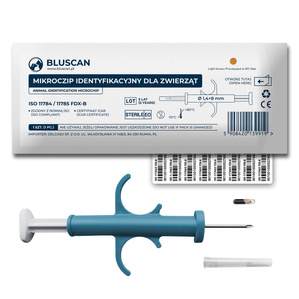
- 8mm Mini Microchip (Bestseller)
The best choice for cats, ferrets, and small dogs (up to approx. 15 kg). A thinner needle means less pain and stress during injection while maintaining excellent readability. - 12mm Standard Microchip
The classic. Dedicated to large dogs, horses, cattle, and Zoo animals. The largest antenna coil ensures maximum read range through thick skin and fur. - 7mm Nano Microchip
A specialized solution. Created for fish, reptiles, small rodents, and miniature dog breeds (under 1.5 kg). Ultra-thin cannula for the most delicate tissues.
Technical Comparison of Bluscan Transponders
To help you decide, we have prepared a summary of key parameters of our implants:
| Size / Type | Needle Diameter | Recommended Use |
|---|---|---|
| Nano (7mm) | Ultra-thin | Fish, Reptiles, Mice, "Toy" Dogs |
| Mini (8mm) | Reduced (Low pain) | Cats, Ferrets, Small breed dogs (Yorkie, Maltese) |
| Standard (12mm) | Standard | Medium/Large Dogs, Horses, Llamas, Livestock |
Safety and Open System
At Bluscan, we believe in freedom of choice. Our microchips are open system (unlocked). This means you can register the unique 15-digit animal number in ANY database (e.g., national registries, international databases like Europetnet compliant ones). We do not force you to use a specific registry or pay subscriptions.
Each implant is coated with Parylene C. This is a biocompatible substance that acts as an "anchor" - integrating with the subcutaneous tissue to prevent the chip from moving (migrating) within the animal's body.
For Professionals (B2B)
Do you run a veterinary clinic or breeding program? Visit the Microchip Sets category. We offer packs of 10 and 20 units, allowing you to significantly lower the unit cost of the procedure while maintaining full sterility of each applicator.
FAQ - Facts and myths about microchipping
No. This is the most common myth. A microchip has no battery or GPS transmitter. It is a passive device - it activates only for a fraction of a second when a reader is brought close to it to transmit the ID number. It does not allow for real-time tracking of the animal on a map.
Yes. It is a routine procedure, comparable to administering a vaccine. Thanks to sterile disposable applicators, the risk of infection is negligible, and the anti-migration coating ensures implant stability for the animal's lifetime.
Need a reader?
The microchip itself is only half the battle. To read the number, you need a reliable scanner. Check out our microchip readers compliant with FDX-B and HDX standards.
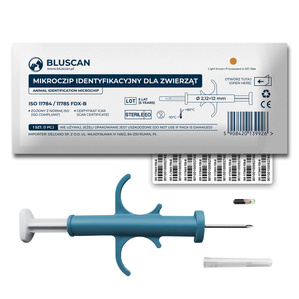
Microchip Bluscan 12mm Standard for Dogs & Cats – 1 pc with Applicator
![RFID Microchip Bluscan 12mm Standard – Set [10 pcs]](/hpeciai/82ea1a6a80696eac3b5ebe3dffecc0d7/eng_is_RFID-Microchip-Bluscan-12mm-Standard-Set-10-pcs-11950.jpg)
RFID Microchip Bluscan 12mm Standard – Set [10 pcs]
![Set [10 pcs] RFID Microchip Bluscan 8mm Mini – Multipack](/hpeciai/020ce83cf76c147ff5119a587563c36b/eng_is_Set-10-pcs-RFID-Microchip-Bluscan-8mm-Mini-Multipack-11953.jpg)
Set [10 pcs] RFID Microchip Bluscan 8mm Mini – Multipack
![Set [20 pcs] RFID Microchip Bluscan 12mm Standard – Multipack](/hpeciai/3240d7ca24caedd3b0d12097359135e8/eng_is_Set-20-pcs-RFID-Microchip-Bluscan-12mm-Standard-Multipack-11955.jpg)
Set [20 pcs] RFID Microchip Bluscan 12mm Standard – Multipack
![Set [20 pcs] RFID Bluscan Microchip 8mm Mini – Multipack](/hpeciai/3e47d91efcfcbf2a922a8dc7e01baf4a/eng_is_Set-20-pcs-RFID-Bluscan-Microchip-8mm-Mini-Multipack-11956.jpg)
Set [20 pcs] RFID Bluscan Microchip 8mm Mini – Multipack
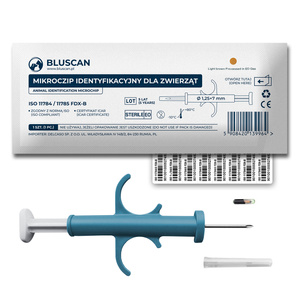
RFID Microchip 7mm Bluscan Nano for Exotics, Fish & Teacup Dogs – 1 pc with Applicator
![Set [10 pcs] RFID Microchip 7mm Bluscan Nano – Multipack](/hpeciai/3454c9fc5bfdef65ab173b59ddd0426d/eng_is_Set-10-pcs-RFID-Microchip-7mm-Bluscan-Nano-Multipack-12465.jpg)
Set [10 pcs] RFID Microchip 7mm Bluscan Nano – Multipack
![Set [20 pcs] RFID Microchip 7mm Bluscan Nano – Multipack](/hpeciai/d2e52dc0796f9a196f7807b66da01d87/eng_is_Set-20-pcs-RFID-Microchip-7mm-Bluscan-Nano-Multipack-12466.jpg)